
Cars
TOP EV CARS 2026
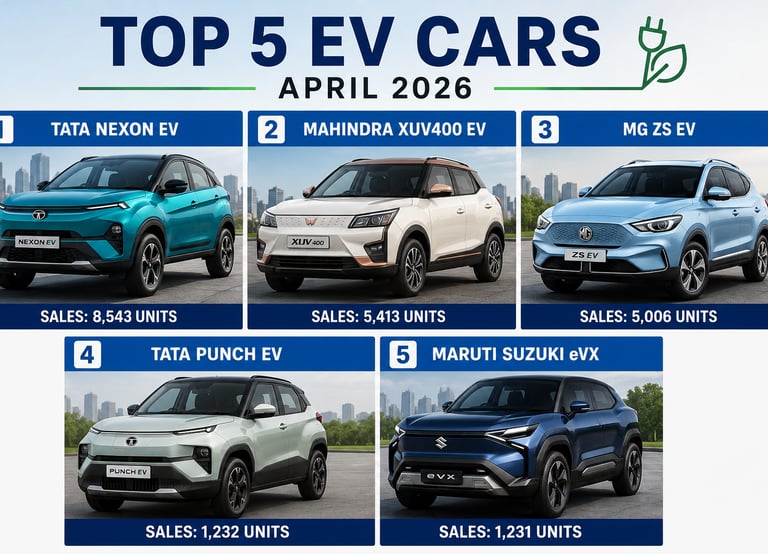
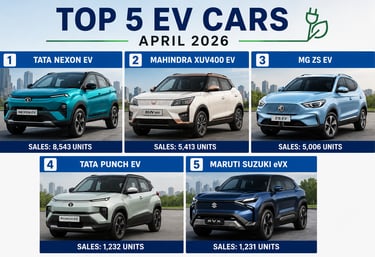
TOP 10 EV CARS APRIL 2026
BrandSales
Tata Motors - 8543
Mahindra - 5413
JSW MG Motor - 5006
VinFast - 1232
Maruti Suzuki - 1231
Hyundai - 516
BYD - 469
Kia - 342
BMW - 300
Mercedes-Benz - 104
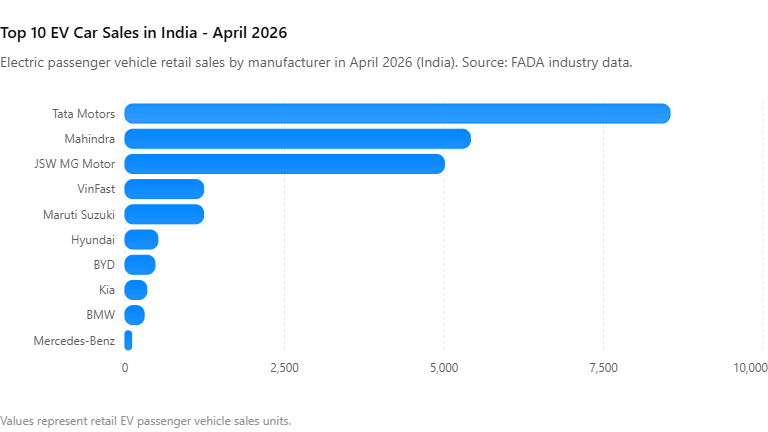
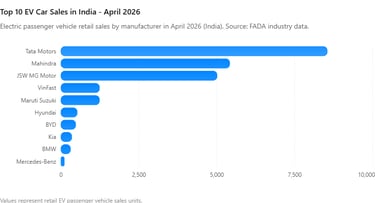
India EV Market Sales and Development – April 2026
India’s electric vehicle (EV) industry continued its rapid transformation in April 2026, marking another milestone month for the country’s automotive sector. Strong consumer demand, aggressive product launches, rising fuel prices, improving charging infrastructure, and government support helped EV sales register impressive year-on-year growth across passenger vehicles, two-wheelers, and commercial mobility segments.
April 2026 proved especially significant because EV sales remained strong even after the financial year-end buying rush of March. Traditionally, April is considered a slower month for automobile retail sales in India. However, the electric mobility segment defied expectations and demonstrated that EV adoption is no longer limited to early adopters. The market is gradually entering the mainstream.
According to Federation of Automobile Dealers Associations (FADA) retail data, India’s electric passenger vehicle sales reached 23,506 units in April 2026, registering a massive 75.14% year-on-year growth compared to April 2025. Month-on-month sales also increased by around 4.5%, indicating sustained momentum after the March sales surge.
The broader EV ecosystem also performed strongly. Electric two-wheelers crossed 1.48 lakh units, while electric three-wheelers continued steady expansion, highlighting how EV adoption is spreading across different transportation categories.
Strong Growth in Passenger EV Segment
The passenger electric vehicle segment remained the fastest-growing area of the Indian automobile market. EV penetration in the passenger vehicle segment reached around 5.8% in April 2026, up from 3.7% during the same period last year.
Several factors contributed to this growth:
Rising petrol and diesel prices
Lower running costs of EVs
Expansion of charging infrastructure
New EV launches
Better driving range
Government incentives
Increasing environmental awareness
Indian consumers are now more willing to shift from traditional internal combustion engine (ICE) vehicles to electric mobility. Earlier concerns such as range anxiety, battery life, and charging convenience are gradually reducing as technology improves.
The market is also becoming more competitive. Earlier, Tata Motors dominated India’s EV market almost without competition. In 2026, however, strong challenges emerged from Mahindra, MG Motor, BYD, VinFast, Hyundai, Kia, and Maruti Suzuki.
Tata Motors Continues Market Leadership
Tata Motors remained the market leader in April 2026. The company sold 8,543 electric passenger vehicles during the month, recording approximately 77% year-on-year growth.
Tata’s EV success continues to be driven by models such as:
Tata Nexon EV
Tata Punch EV
Tata Tiago EV
Tata Curvv EV
The company benefits from:
Wide dealership network
Affordable pricing
Strong localization
Early-mover advantage
Growing charging partnerships
Despite increased competition, Tata still controls a major share of India’s electric car market. However, the company is facing pressure from new entrants offering advanced technology, premium interiors, and longer driving range.
Industry analysts believe Tata will need continuous innovation to maintain its dominance over the next few years.
Mahindra Emerges as the Biggest Challenger
Mahindra & Mahindra became the second-largest EV player in April 2026 with sales of 5,413 units. The company registered nearly 64% annual growth and managed to outperform MG Motor for the second consecutive month.
Mahindra’s rapid growth is being driven by its new-generation electric SUV portfolio, including:
Mahindra XEV 9e
Mahindra BE 6
Mahindra XUV400
Mahindra XEV 9S
Mahindra has aggressively invested in EV technology and dedicated electric platforms. Reports suggest the company plans major investments through FY2027 to strengthen its electric SUV portfolio.
Many consumers are now considering Mahindra EVs because of:
Futuristic design
Better performance
Long driving range
Advanced infotainment systems
Improved brand perception
Social media discussions and automotive communities indicate growing excitement around Mahindra’s EV products. Some users even believe Mahindra could challenge Tata’s long-standing leadership position in the coming years.
MG Motor Maintains Strong Presence
JSW MG Motor sold 5,006 EV units in April 2026 and remained one of the strongest players in the market.
The company’s growth is supported by:
MG Windsor EV
MG ZS EV
MG Comet EV
MG has established itself as a technology-focused EV brand in India. The company attracts urban customers who want premium features, connected technology, and modern design.
The compact MG Comet EV especially gained popularity among city buyers because of its affordability and practicality for urban commuting.
Entry of New Players Intensifies Competition
One of the most important developments in April 2026 was the emergence of new EV manufacturers in India.
VinFast’s Rapid Growth
VinFast crossed 1,200 units in monthly sales, signaling strong early momentum in the Indian market.
The Vietnamese EV maker is aggressively expanding globally and sees India as a strategic growth market. Competitive pricing and modern vehicle designs helped the company gain quick attention.
Maruti Suzuki’s EV Entry
Maruti Suzuki also crossed 1,200 EV units in April 2026.
Maruti’s EV strategy is extremely important because the company dominates India’s passenger vehicle market. Its entry into electric mobility is expected to accelerate mass EV adoption, especially in smaller cities and middle-class households.
Consumers trust Maruti because of:
Affordable maintenance
Large service network
High resale value
Reliability
If Maruti successfully prices its EVs competitively, the company could significantly reshape India’s EV landscape over the next few years.
Luxury EV Segment Expands
Luxury electric vehicles also showed strong growth in April 2026. Brands such as:
BMW
Mercedes-Benz
BYD
continued expanding their EV presence in India.
Premium consumers are increasingly adopting EVs because luxury brands now offer:
High-performance electric SUVs
Long-range battery technology
Fast charging
Advanced autonomous features
Premium interiors
The luxury EV market remains small compared to mass-market segments, but it is growing rapidly and improving overall EV awareness in India.